After nearly 50,000 kilometres on foot, Karl Bushby has returned to Hull, ending a journey delayed by border hurdles, logistics and global events.
Karl Bushby’s 28-year journey around the world ended in Hull on Monday, where hundreds of supporters welcomed the 57-year-old back to his home city. He’d set out expecting the trip to take about 10 years, a forecast that proved far removed from the reality of crossing continents on foot and by other means under his own steam. The distance was nearly 50,000 kilometres, but the time it took reflects a journey shaped as much by borders, paperwork and world events as by physical endurance.
After greeting the crowd, Bushby continued to his family home with his possessions in a trolley and an unused spare tyre strapped on top. His mother, Angela, his 36-year-old son and his 12-year-old granddaughter were waiting there. The return had a domestic scale that sat alongside the epic length of the trip: after decades away, he was back among family in the city where he began.
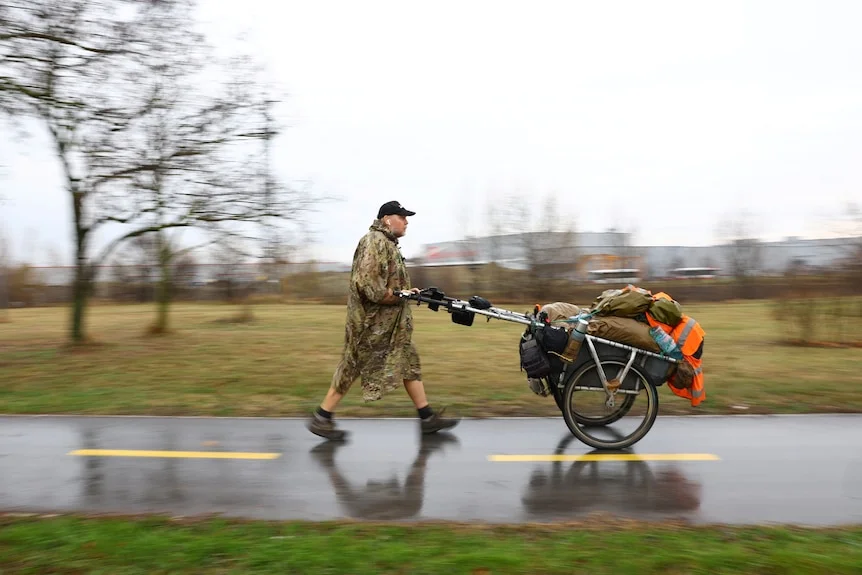
The British ex-paratrooper Karl Bushby spent 28 years accomplishing a journey he initially predicted would only take 10 years. (Reuters: Bernadett Szabo)
A route shaped by setbacks
Bushby began in Chile, inspired by his father’s question about whether it was possible to walk from London to New York. Carrying a tent, a few hundred dollars and a basic plastic camera, he travelled north through the Americas, crossed from Alaska to Russia, then continued through Mongolia and China before returning to Europe. The route turned a family question into a practical test of how far a person could get by continuing on foot, even when geography and borders complicated the plan.
His itinerary included very different kinds of terrain and travel. He cut through Central American jungles, crossed Arctic ice and swam the Caspian Sea, experiences that demanded more than simply covering distance day after day. The expedition’s variety is part of what makes its scale difficult to grasp: “around the world” can sound like a single continuous trek, but Bushby’s account points to a sequence of distinct physical and logistical challenges.
The journey’s final stretch included a swim across the English Channel last month. Bushby described the long stretches of travel as mentally demanding, telling Reuters last year that deserts could look unchanged for days or weeks. “That can get a little mind-bending. The same with the Arctic.” It’s a reminder that endurance here wasn’t only a matter of fitness; it also meant coping with repetition and isolation over long periods.
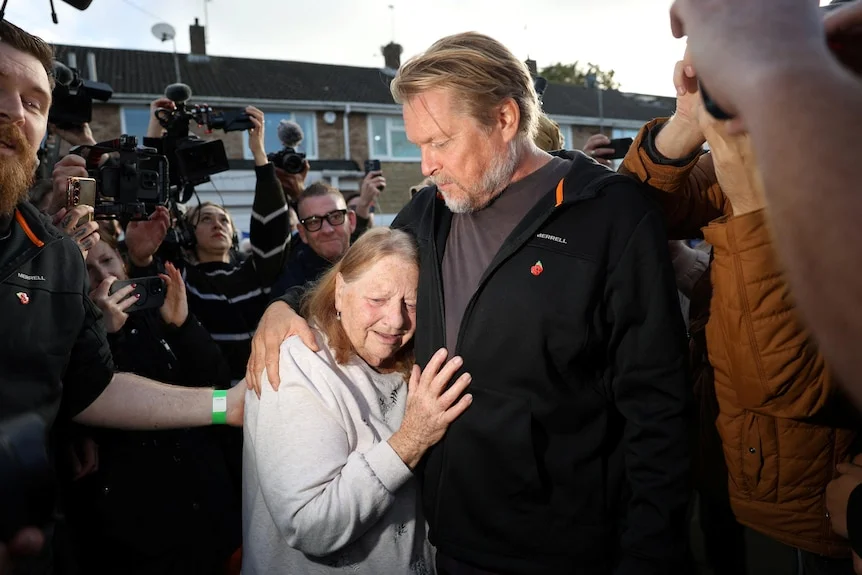
Karl Bushby reunites with his mum, Angela, at the end of his 28-year adventure. (Reuters: Temilade Adelaja)
Only about 15 of the 28 years were spent walking, Bushby told the BBC. The remainder included time in Mexico arranging visas, logistics and sponsorship, an account that complicates the popular image of a solitary traveller simply putting one foot in front of the other. Long expeditions depend on practical support and permissions as well as stamina; when those pieces aren’t in place, progress can stop altogether.
He also faced imprisonment in Panama, an armed confrontation in Mexico and detention by Russian authorities after an illegal border crossing. The 2008 financial crisis and COVID pandemic added further delays. These interruptions weren’t minor detours around an otherwise predictable route: they show how a personal undertaking can become dependent on political circumstances and events far beyond the traveller’s control.
“This is what an odyssey in the 21st century looks like,” he told the Telegraph, describing how geopolitical and bureaucratic problems could require him simply to wait. That’s a more grounded picture than the usual adventure story, which tends to make hardship look like a test that determination alone can solve. Sometimes the next step is paperwork, money or patience. A long pause.
What the journey says about endurance
The 28-year figure is striking, but it can also obscure the different kinds of work involved. Walking accounts for only part of the total; planning, obtaining visas, arranging sponsorship and responding to delays took up the rest. For anyone thinking about similarly ambitious travel, that distinction matters: a route drawn on a map doesn’t show the systems and contingencies that determine whether a traveller can keep moving.
This is more significant than it looks. Bushby’s return makes visible the gap between an ambitious idea and the conditions required to carry it through. The journey began with a question about whether a route was possible, but its completion depended on adapting as circumstances changed. If you’re working in this space, the lesson is less about copying the feat than recognizing how much of any long project happens outside its headline activity.
There’s also a human cost to measuring such an undertaking only by distance. Bushby’s family waited through a journey that lasted far longer than he initially expected, while he spent years away from home. The welcome in Hull brought those two timelines together: the traveller’s return and the family’s reunion. And yet, the source account offers no simple formula for what made the journey possible. It records the obstacles and the outcome, leaving the achievement to speak for itself.
What comes next
At the welcome in Hull, Bushby told the crowd, “After 28 years, you just couldn't ask for more than this.” He then set off toward home, adding: “I guess I'll be seeing you around.” The exchange has the ease of someone returning to familiar streets, even after an undertaking that kept him away for decades.
A feature-length documentary about the journey is in production, and he’s expected to begin a speaking tour around England in the coming weeks. Those projects will give Bushby a chance to tell the story in more detail, including the stretches that a simple route summary can’t convey: the waiting, negotiations and mental strain behind the miles. The public account may focus on the remarkable duration and distance. The harder, more useful story is how the expedition kept changing shape—and how he kept finding a way to continue.
Discussion
Sign in to join the discussion.