France is reinforcing security and restricting gatherings after riots hit major cities, as officials prepare for another weekend of protests.
Security response shifts into higher gear
France’s response to a wave of destructive protests is shifting toward tighter street controls and a large security deployment. The government has acknowledged shortcomings in its handling of the unrest, while preparing for another round of demonstrations this weekend. That combination puts officials under pressure to show they can protect public spaces without treating the causes of public anger as a problem that patrols alone can solve.
Prime Minister Sebastien Lecornu said troops would reinforce police ahead of the planned protests. “The deployment next Saturday will be massive,” he said. For now, he added, the priority is restoring order after clashes, looting and fires in Paris, Marseille, Lyon and other cities. The emphasis on a large deployment signals how seriously the government views the risk of renewed disorder, though the size of a security operation by itself says little about whether it can prevent violence or reassure residents.
Curfews and gathering bans spread
After a comparatively quiet night, authorities imposed overnight restrictions around Paris’s Place de la Republique, from 11pm Tuesday until 6am Wednesday. Police had cleared and guarded the square the previous night, with a helicopter overhead. The restrictions put a defined time and place around police efforts to keep people from regrouping there, but the quiet night offers only a limited measure of whether tensions have eased.
A separate ban on public gatherings took effect from 8pm Tuesday in several central areas, including Les Halles, the Champs-Elysees, Place Vendome, areas near the presidential palace and the parliament and senate buildings, and locations around train stations. The breadth of those locations shows how authorities are trying to protect sites with political, commercial and transport importance at once. Such measures can make it harder for crowds to assemble in central districts, while also narrowing where residents can gather during a period of intense public frustration.
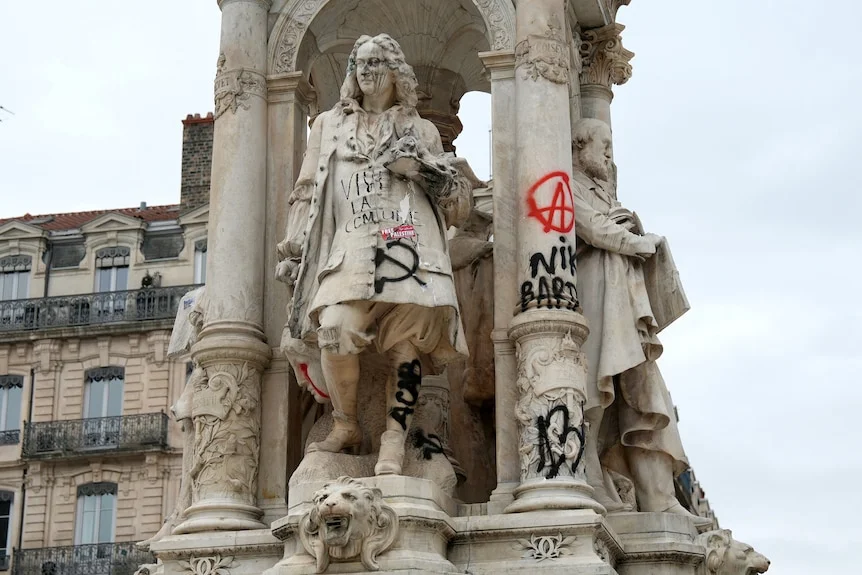
Demonstrations have been fuelled by unhappiness over the cost of living and rising fuel prices. (Reuters: Cecile Mantovani)
Measures vary by city. In Lille, where restrictions applied only to minors, officers patrolled the centre and checked people’s identities. Marseille mayor Benoit Payan said minors would face curfews around commercial districts hit hardest by the weekend’s disorder. The different approaches reflect local decisions about where authorities see the immediate risk, while placing restrictions on movement that may affect people who weren’t involved in the violence.
The protests have been driven by anger over living costs and poor conditions in schools, alongside dissatisfaction with public services. Those grievances point to a dispute broader than the destruction of property: people are also expressing frustration with the conditions of daily life and the services they rely on. Lecornu blamed far-left groups, casting the crisis as a choice “between violence and the Republic.” Those groups have accused the government of failing to grasp the depth of public anger. That divide matters because the government’s account of who is responsible may not persuade people whose complaints concern prices, schools and public services.
Investigations and political pressure
Parliament is establishing a commission to examine what caused the unrest. Authorities have assigned 200 investigators to identify people involved in the street violence. The commission and the police investigation serve different purposes: one is intended to examine the causes, while the other is focused on identifying those who took part in violence. Both will be judged by what they establish, not simply by the fact that they’ve been announced.
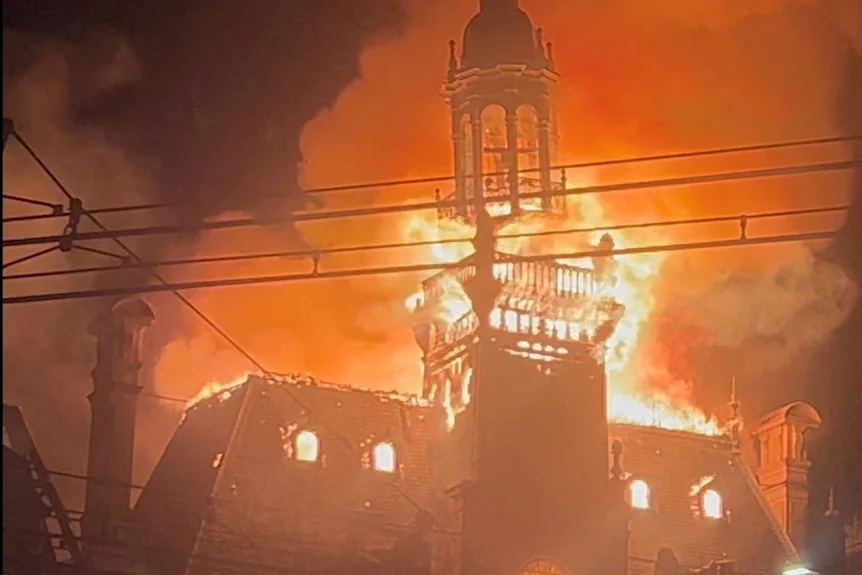
A man has been arrested suspected of starting a blaze that destroyed a historic town hall in the central city of Limoges. (Reuters: Lucas Destrem)
Police arrested a man suspected of setting fire to Limoges’s historic town hall, which was destroyed during the unrest. Officials said he was on a security watch-list and belonged to an ultra-left group. The arrest gives investigators a specific suspect in a serious act of destruction, but it doesn’t explain the wider causes of the protests or establish who else was involved.
The scale of the violence and the apparent difficulty police had containing it have intensified political tensions ahead of next year’s presidential election. Far-right and hard-left candidates are performing strongly in polls. Protests in Italy and Albania have also heightened concern that frustration over living standards could spread, as France and other countries face strained public finances. This is more significant than it looks: disorder is unfolding alongside political competition over how to interpret public anger, giving the government little room to treat the unrest as a purely operational problem.
The test beyond this weekend
The immediate test for the government will be whether its expanded security operation can contain this weekend’s demonstrations while public anger over prices and services remains unresolved. If you’re working in this space, the distinction to watch is between controlling a crowd on a particular night and addressing the complaints that brought people into the streets. One can happen quickly. The other takes longer, and the article’s central tension is that France is preparing urgently for the first while still facing the second.
Here’s the thing: restrictions and deployments may limit opportunities for clashes, but they can’t by themselves settle competing claims about why the protests began or whether officials have understood them. (And this is the part most people overlook.) A quieter night would be a useful sign, not proof that the crisis has passed. For now, the country faces a weekend security test and a longer political question about public trust. No easy answer.
Discussion
Sign in to join the discussion.