Prosper Australia estimates Australia could raise up to $45 billion more annually from resource industries, while noting that international comparisons have limits.
The $45 billion question
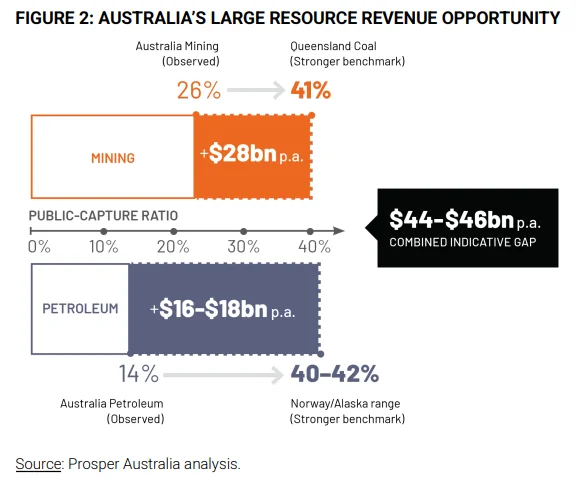
Australia’s resource tax system may leave as much as $45 billion a year uncollected when commodity prices and company profits rise. That’s the central claim from Prosper Australia, a tax reform think tank, and it turns a familiar argument about mining taxes into a sharper question: who should benefit when finite public resources become unusually valuable? The group says governments should collect more during commodity booms, while still allowing companies a commercial return for the capital, technology and expertise they bring. Coal, iron ore and gas belong to the public, it argues; once extracted and sold, they’re gone. The report calls for changes to the tax system so public revenue rises more automatically when resource profits surge. The headline estimate spans state and Commonwealth revenue. Prosper Australia puts the potential increase at about $28 billion a year from mining, including coal, iron ore, gold, copper, lithium and other minerals, plus $16 billion to $18 billion from oil, gas and LNG.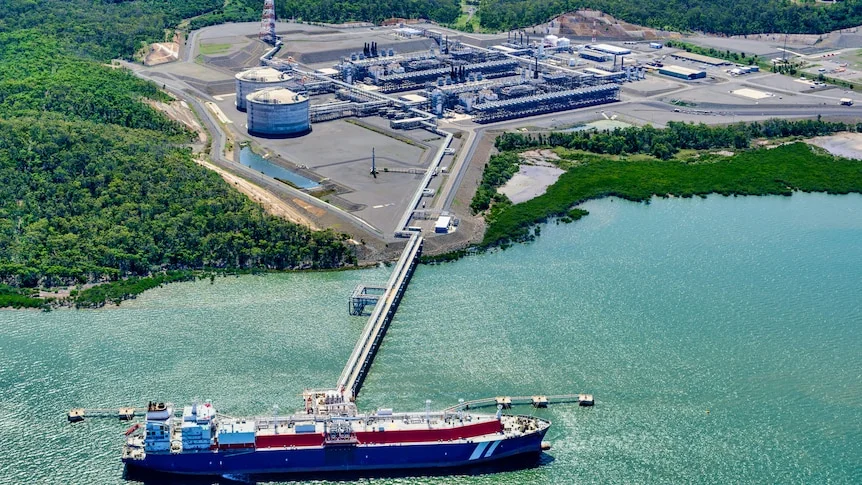
Comparisons need context
The report measures “public capture” as the share of value created by resource industries that reaches the public. On that measure, Australia’s petroleum sector fares poorly against Norway and Alaska. But the comparison has limits: Norway’s model includes state participation in projects, unlike Australia’s private-operator system. Prosper Australia removes that activity from Norway’s figures to make the comparison closer, and adjusts Alaska’s numbers too. Mining tells a more complicated story. Australia’s public-capture ratio is higher than the observed ratios for Québec, Chile and Peru, despite relying heavily on low, flat royalties while those peers use more boom-sensitive regimes. The report says that result doesn’t prove Australia’s system is well designed. Commodity mix, prices, project age and operating costs all shape what governments collect. Australia has large, mature, high-volume iron ore and coal industries; the comparison countries produce different minerals under different cost conditions. Tax administration and compliance can also affect the figures. The data offers a useful warning against simple rankings, but it doesn’t isolate the effect of tax design.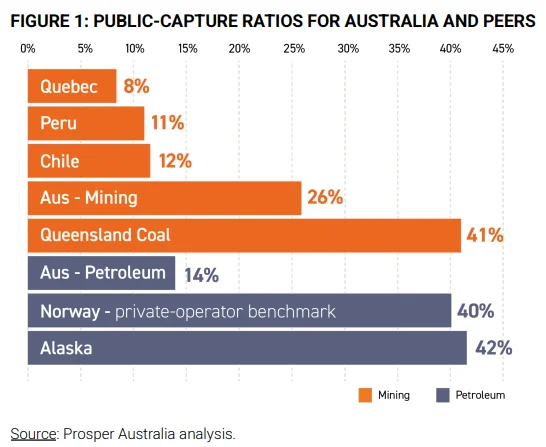
A tax can look strong on paper
Australia’s Petroleum Resource Rent Tax was designed to tax exceptional profits from offshore petroleum projects, giving it high theoretical sensitivity to a boom. In practice, it hasn’t delivered strong, timely revenue, and current forecasts show no sustained improvement. That’s a useful distinction for anyone weighing resource-tax proposals: a tax’s stated purpose doesn’t tell you how it will perform. Prosper Australia argues that generous or complicated rules can leave a rent tax collecting far less than its design suggests. The PRRT’s record, the report says, is a case for better rules, not proof that taxes on super-profits cannot work.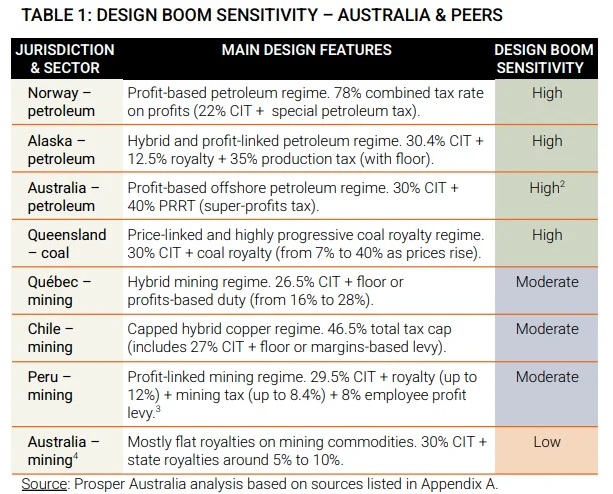
Discussion
Sign in to join the discussion.