A year after Tino, Cebu residents report recurring floods and unresolved relocation concerns, while civic groups press for accountability and long-term recovery.

A year after Typhoon Tino devastated Cebu, residents are still asking whether their homes will be safe in the next storm. Flooding continues in some communities during ordinary rain, many families lack permanent relocation, and civic groups say key flood-management proposals remain unfinished or unverified.
Those concerns shaped the November 4 anniversary discussions in Padayon Cebu, a chat room on Muni in the Rappler app. Survivors and local advocates revisited what happened, described conditions in affected areas and considered what recovery should require. The anniversary also brought a downtown walk focused on urban vulnerability and a dialogue on flood-control accountability.
Before the anniversary, participants opened a discussion titled “Isang taon matapos ang Tino, kamusta na ang Cebu?” — How is Cebu a year after Typhoon Tino? The accounts shared there put personal loss alongside ongoing questions about safety, relocation and the effectiveness of flood-control efforts.
Flood risk persists after the storm
Jerome Valdez, a Cebu-based Mover, shared the experience of Alma Quingco, 46, from Barangay Maslog in Danao City. Quingco was on duty at the University of the Philippines Cebu when Tino struck. By the time she returned, floodwaters had blocked access to her home and swept away many of her belongings.
Valdez said the event left Quingco with lasting fear and trauma. The speed at which the water rose remains vivid for her, even after a year and despite the help she received. Her account points to a lasting effect that’s harder to measure than damage to buildings: the continuing anxiety residents carry into each bout of heavy rain.
In Tambisan, severe flooding has continued even during ordinary rainfall, according to participants in the discussion. Some families whose homes were destroyed by Tino still lack safe, permanent relocation.
Violy Musngi of La Paloma Village described the shock of the flooding during Rappler’s #MoveCebu roadshow in October. Water reached waist height in her area and rose above head level in Tambisan. She said flooding continued after the typhoon, with even light rain now bringing water into communities quickly. Musngi also reported cases of leptospirosis among Tambisan residents.
These accounts make the anniversary less a marker of recovery than a check on whether everyday conditions have changed. For residents facing repeat flooding, the central issue is immediate: whether they can stay safely in their homes, and where they can go if they cannot.
Proposals remain short of implementation
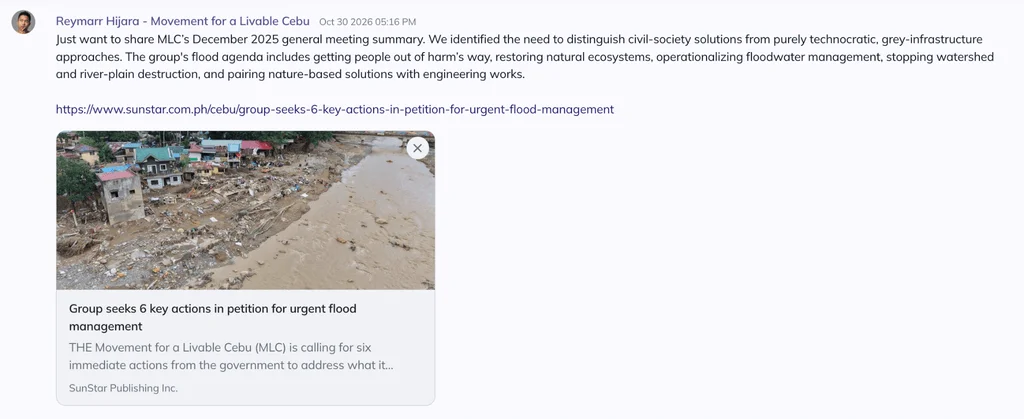
Reymarr Hijara of the Movement for a Livable Cebu (MLC), a civic group advocating safer, more sustainable flood management, joined the online discussion. In November 2025, MLC proposed six urgent measures in a petition for urgent flood-management measures. The proposals included creating a Cebu Floodwater Management Office, relocating families from high-risk areas, protecting watersheds and reviewing flood-control structures. The group also called for no-build zones in areas inundated during Tino.
Hijara said the six proposals remained largely unfinished or unverified a year later. The most concrete development, in his account, was an invitation for MLC to join the Provincial Flood Control and Drainage Task Force. The task force was created under Executive Order 74 after flooding in November 2025.
Joining the task force, Hijara stressed, does not establish that the proposed measures have been carried out. “A task force is not yet implementation,” he said. The distinction matters: forming a body creates a venue for work, while residents are still waiting to see whether that work changes flood exposure and relocation options.
A walk through Cebu’s urban vulnerabilities
Two activities marked the anniversary on November 4. One was a sustainability walk through downtown Cebu, organized by the University of the Philippines Cebu’s College of Communication, Art, and Design (CCAD), with participants from the University of the Philippines Open University and Japan’s Meiji University.
The guided route went through San Nicolas, Pasil, Taboan, Carbon Market, Plaza Independencia and Colon. Participants looked at the city’s built environment, public spaces, transport systems and cultural heritage, using the walk to consider how those elements shape communities’ exposure to environmental hazards.
CCAD Dean Crina Tanongon said Tino’s severe flooding informed the discussion about adapting cities to floods and extreme heat while preserving their cultural identity. She explained why the organizers chose to walk the route: “We chose a guided walk because remembering is not merely a cognitive exercise. It is sensory and embodied.”
The event also compared climate-adaptation approaches in the Philippines and Japan, asking what Cebu might learn as it works toward safer, more livable communities. The format gave participants a direct way to consider how infrastructure, public space and heritage meet in the neighborhoods affected by flooding.
Accountability and relocation at the center of dialogue
A separate gathering brought survivors and civic groups together to discuss continuing concerns. Sugbuanong Pakigbisog Kontra Kurapsyon (SuPaKK), with partner organizations, organized the multi-stakeholder dialogue “Kahinumdom pa mo namo?” — Do you still remember us? The meeting focused on flood-control accountability and the needs of people affected by Tino.
John Roy Rigodon of the Sectoral Transparency Alliance on Natural Resource Governance (STANCe) shared observations from visits to communities along major Cebu rivers. His visits included areas beside the Kinalawan River in Toledo City and the Cotcot River in Liloan and Compostela. He said residents in flood-prone areas continue to worry about their safety when typhoons arrive, including whether they have a secure place to go.
“Will they be safe in the next typhoon?” Rigodon asked, identifying relocation as a major concern. That question connects emergency preparedness to a longer-term problem: families need housing in places where they can remain safe, not just temporary shelter after a flood.
The dialogue also raised questions about public spending on flood-control projects. Organizers cited P17.4 billion in major river flood-control projects from 2016 to 2025, including P11.1 billion for the Butuanon River, and called for transparency and accountability. The figures were also reported in a SunStar Cebu investigation into how Tino’s floods exposed how flood control projects failed in Cebu.
Norika Ishikawa of the Cebu Anti-Corruption Coalition and Center for Emergency Aid, Rehabilitation and Development Inc. (CONCERN) questioned how rehabilitation would be led amid reported cuts to disaster rehabilitation and housing funds for 2027. She argued that recovery should extend beyond the provision of houses: residents need safe, affordable homes with access to jobs, utilities, roads, hospitals and schools.
“Disaster rehabilitation is not an expense. Building back better is a public investment,” Ishikawa said. The dialogue identified two next steps: developing a relocation agenda with informal settler families affected by Tino and mobilizing for an accountability action on November 30. Ishikawa described the mood as painful and angering in the face of inaction, while adding that hope remained.
The scale of the damage still shapes recovery
Tino affected nearly 2 million people in Cebu, displaced more than 636,000 and caused 96 confirmed deaths, with many people still missing. The typhoon damaged about 262,000 homes, more than 24,000 of them destroyed completely. Those figures help explain why recovery remains a live issue for communities a year later.
The anniversary discussions brought the continuing needs into focus: residents are seeking safe relocation, clearer answers about flood-control spending and rehabilitation that supports daily life over the long term. The next test for Cebu’s flood-management efforts is whether plans and task-force discussions translate into safer homes and fewer communities exposed to the next storm.
Discussion
Sign in to join the discussion.