Philippine Economic Growth Forecast Revised Down Amid Investment Slowdown and Energy Pressures
Oct 05, 2026 · 391 views
The ASEAN+3 Macroeconomic Research Office has downgraded the Philippines' growth projections for 2026 and 2027 due to investment issues and global energy challenges.
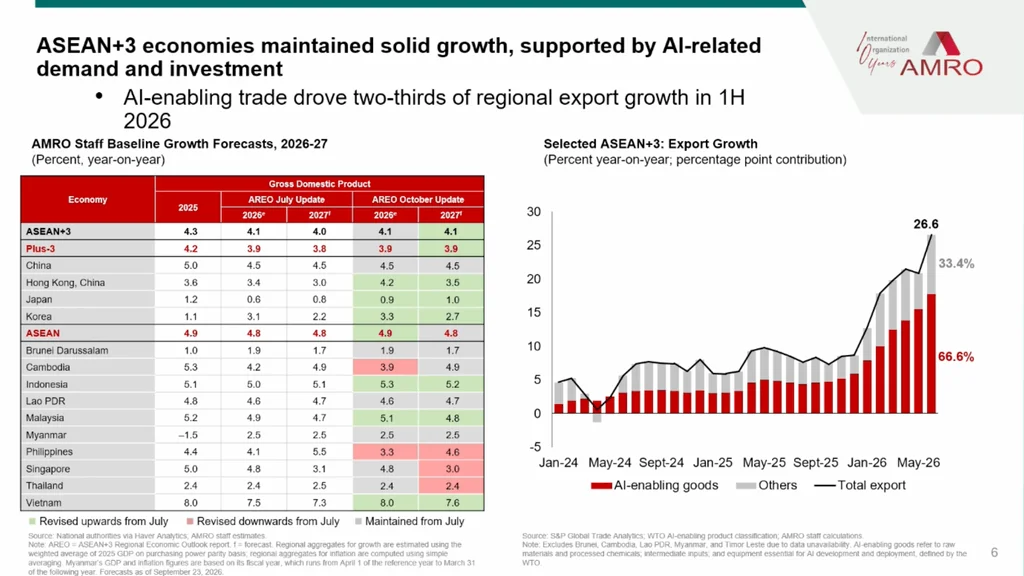
The ASEAN+3 Macroeconomic Research Office (AMRO) has revised its growth forecasts for the Philippines, slashing the outlook for 2026 to 3.3%, down from a previous estimate of 4.1%. The outlook for 2027 is similarly diminished, shifting from 5.5% to 4.6%. In contrast, the broader ASEAN+3 region is projected to grow by 4.1% during these years, with Vietnam notably outperforming at 8.0% in 2026 and 7.6% in 2027.
NEW OUTLOOK. The table shows that AMRO has cut the Philippines’ growth outlook for 2026 and 2027. Photo from AMRO briefing.
Revisiting Growth Projections
This latest adjustment comes on the heels of AMRO's earlier consultation with Philippine officials in August, when it had already lowered the growth expectations to 3.4% for the current year and 4.8% for next year. The revisions are striking, particularly given that the Philippines is part of a region where growth is expected to remain relatively strong.
Analysts often point out that the Philippines has been viewed as a rising star in Southeast Asian economic circles. However, the persistent downgrades raise questions about the fundamentals driving this growth. The organization previously highlighted an anticipated reduction in private consumption linked to rising prices and a sluggish investment climate, which is a familiar tune in many emerging economies.
Often, when consumer sentiment is dampened by inflationary pressures, you see a direct impact on GDP growth as spending contracts. Given the current climate, significant adjustments to these forecasts affect not just policymakers but also investors and businesses planning future investments.
Energy Price Shock and Domestic Challenges
AMRO's chief economist, Dong He, expressed concern during a briefing on October 5, stating, “The Philippines is one of the economies that was hit harder by the energy shock,” noting that this has led to slowed growth and an uptick in inflation. The report identifies prolonged high global oil prices as a significant factor adversely impacting energy costs.
But here's the thing: while external factors like energy prices do play a substantial role, they aren't the only culprits. Inflation driven by skyrocketing oil prices leads to broad economic repercussions, particularly for a country reliant on imports. This means that Filipinos are feeling the pinch every time they fill up their gas tanks, which in turn reduces disposable income for other spending.
What’s frequently overlooked is the interplay between domestic challenges and external shocks. He pointed out that "the Philippines also had some domestic issues that they need to deal with," specifically referencing the controversies surrounding flood control efforts that have stalled public investments. Such domestic turmoil can create an environment ripe for investor hesitancy.
Public Investment: A Double-Edged Sword
The pace of public investment recovery is deemed crucial for revitalizing growth. This is particularly relevant given that public infrastructure projects can significantly boost economic activity by creating jobs and improving overall productivity. Yet, AMRO has noted concerns around infrastructure project delays, especially those linked to corruption allegations that surfaced in mid-2025. This issue has reportedly led to a staggering 31.5% year-on-year contraction in public construction for the first quarter of 2026.
When investors confront a landscape riddled with delays and potential scandals, their confidence wanes. If you're working in this space, you'll understand the importance of timely implementation of infrastructure projects in not just stimulating growth, but also in fostering an environment conducive to foreign investment.
Investor hesitancy is reflected in capital withdrawals from Philippine equities, a trend AMRO attributes to concerns regarding the current account deficit and the stagnation of crucial infrastructure implementation. When domestic politics impact economic indicators negatively, it reverberates through sectors reliant on foreign capital and expertise.
Some Stabilizers Amid Setbacks
Despite these setbacks, there are some stabilizers in the economy. He mentioned that remittances and the growth of the IT-BPM sector provide a buffer against these fluctuations. While it might seem promising, there's a catch: reliance on remittances can often mask underlying economic inefficiencies.
This leads to another question: how sustainable is this growth model? The significant dependency on remittances as a counterbalance to domestic economic woes might just delay necessary reforms rather than incentivizing them.
Moreover, the IT-BPM sector, while growing, must also navigate challenges like competitive pressure from other countries investing in similar markets. The ability of these sectors to drive long-term growth hinges on effective government policies and a stable economic climate.
Implications for Future Growth
Looking ahead, the implications of these forecasts are troubling. With the World Bank echoing AMRO's concerns and cutting its own 2026 growth forecast for the Philippines to 3.7% from 5.3%, the interconnectedness of these institutions signals a shared perspective on the nation’s economic trajectory.
The fallout from the flood control corruption issue has dampened economic performance. Delays in critical infrastructure projects, caused largely by intensifying scrutiny and audits, could hinder recovery efforts. It’s a complicated web of challenges that seems to pull the Philippines further away from its growth potential.
Simply put, this situation needs urgent attention. Optimizing public investment isn't just about fixing the immediate issues; it's a matter of regaining investor confidence. Without that trust, you can expect more downward revisions in growth forecasts—something no country wants to grapple with.
As these multifaceted challenges play out, the Philippines must muster the resolve and policy coherence to navigate through these turbulent waters. The road ahead won’t be simple, but timely action could shape the nation's economic resilience for years to come.

Discussion
Sign in to join the discussion.